

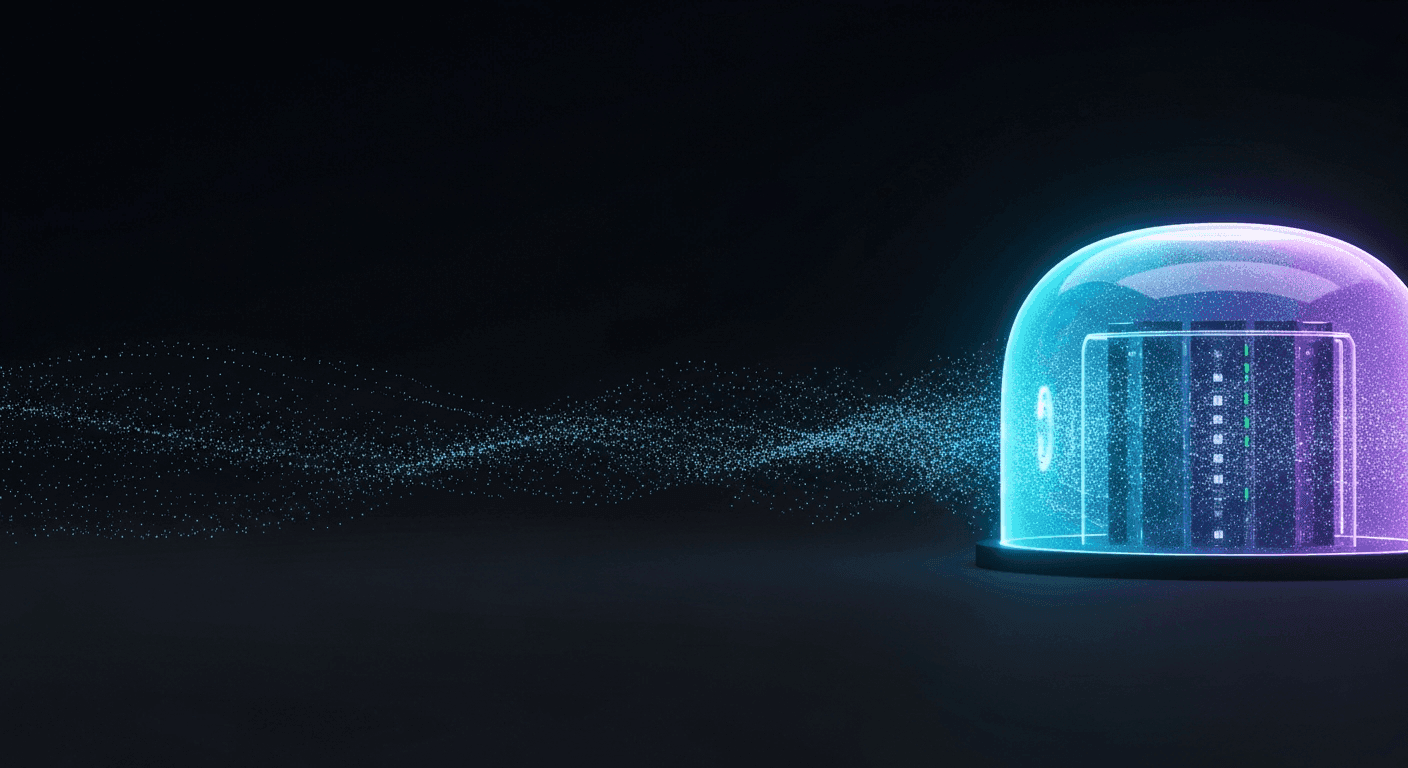
Secure AI
Modern AI on your most sensitive data — without sending it to the public cloud.
Many organizations can't adopt AI because they can't let PHI, PII, or other regulated data go to outside services. VisionWrights solves that two ways: we build private, audited AI environments, and we help you understand and operationalize the rules that govern your data.
In one line
Secure AI is the practice of running analytics and AI on regulated data — PHI, PII, financial, or privileged information — inside an environment the organization controls and can audit, so the data is never sent to a third-party AI service.
The problem
AI adoption keeps dying in security review.
The technology usually works. The deal stalls when someone asks the unavoidable question: where does our data go? Sending PHI, PII, or privileged records to a third-party AI service is a non-starter for most regulated organizations — and the security reviewer is the person who turns that “no” into a “not yet.”
We work the problem from both ends: the environment where the AI runs, and the operational practices that govern the data in the first place.
Two ways we help
Build it, and get it right.
Many clients enter through advisory — “are we even doing this correctly?” — and convert to the build. The two pillars are designed to connect.
Build & operate
Sovereign AI Clean Room
A private, audited environment where ingestion, de-identification, analytics, and AI all run without going to the public cloud. Your data never goes to a third-party AI service. Built for production systems and for the AI development phase — including building against synthetic data when even your developers can't touch the real thing.
- No outside AI ever sees your data
- AI and analytics on PHI, PII, and other regulated data
- Secure for production and for AI development
- A tamper-evident audit trail your reviewers can check
Understand & assess
Compliance & Data-Protection Advisory
Practical, engineering-led guidance on how regulated data must be handled — HIPAA, PHI, PII, BAAs, vendor and subprocessor risk, de-identification, breach readiness, penetration testing, and SOC 2 readiness. We help you assess where you stand and operationalize the fixes.
- HIPAA / PHI / PII fluency, applied to real systems
- Vendor & BAA-chain risk review
- Readiness reviews, gap analysis, and remediation
- Penetration testing and SOC 2 readiness support
Advisory content is practical, engineering-led readiness guidance — not legal advice and not a regulatory certification. You and your counsel own the legal determination.
Proof through breadth
The same capability, across the strictest-data industries.
The constraint is always the same — this data cannot go to outside AI services. The solutions are diverse.
FAQ
Questions security reviewers ask
Can I use AI without sending my data to OpenAI, Anthropic, or Google?
Yes. VisionWrights builds private AI environments where your sensitive data is processed entirely inside a private, audited environment under a BAA. Nothing is sent to a third-party AI service — no outside AI ever sees it.
Is there a HIPAA-aware way to use AI on PHI?
There is. When AI runs inside a private, audited, BAA-governed environment, PHI is never exposed to the public cloud or outside AI — and every action on it is logged in a tamper-evident audit trail. We design the environment; your team and counsel own the compliance determination.
How is this different from cloud AI with a BAA?
A BAA is a contract that allows a cloud vendor to handle your data. A sovereign clean room means your data never goes to the public cloud. For a security reviewer, "no outside AI ever sees it" is a categorically stronger answer than "a vendor promised to protect it."
Which industries do you work with?
We apply this across sectors with the strictest data requirements — healthcare and behavioral health, legal teams handling medical and privileged records, and financial services and insurance under SOC 2 and data-residency obligations — and beyond.
Tell us your data constraints.
Describe what your data can't do — go to the public cloud, touch a third-party API, sit unaudited. We'll tell you what's possible inside a private, audited environment.